Ask most people what makes a good data centre site and they start with the land: size, title, price, access. In Indonesia that instinct is understandable. Java has a deep supply of industrial land, and the estates around Jakarta are used to selling to large occupiers. But for a campus built for AI, the land is rarely what decides whether a project happens on time. The grid connection is.
This piece explains why, what a proper grid test involves, and how to sequence the work so that capital is not tied up in land that cannot be powered when you need it.
Land is the easy part
Finding a flat, well-drained plot with clean title and road access takes work, but it is a solved problem. Industrial estates have masterplans, utilities and experience with foreign buyers. Outside the estates the questions are harder, covering title history, zoning and the local community, yet they can usually be answered within weeks with the right land due diligence.
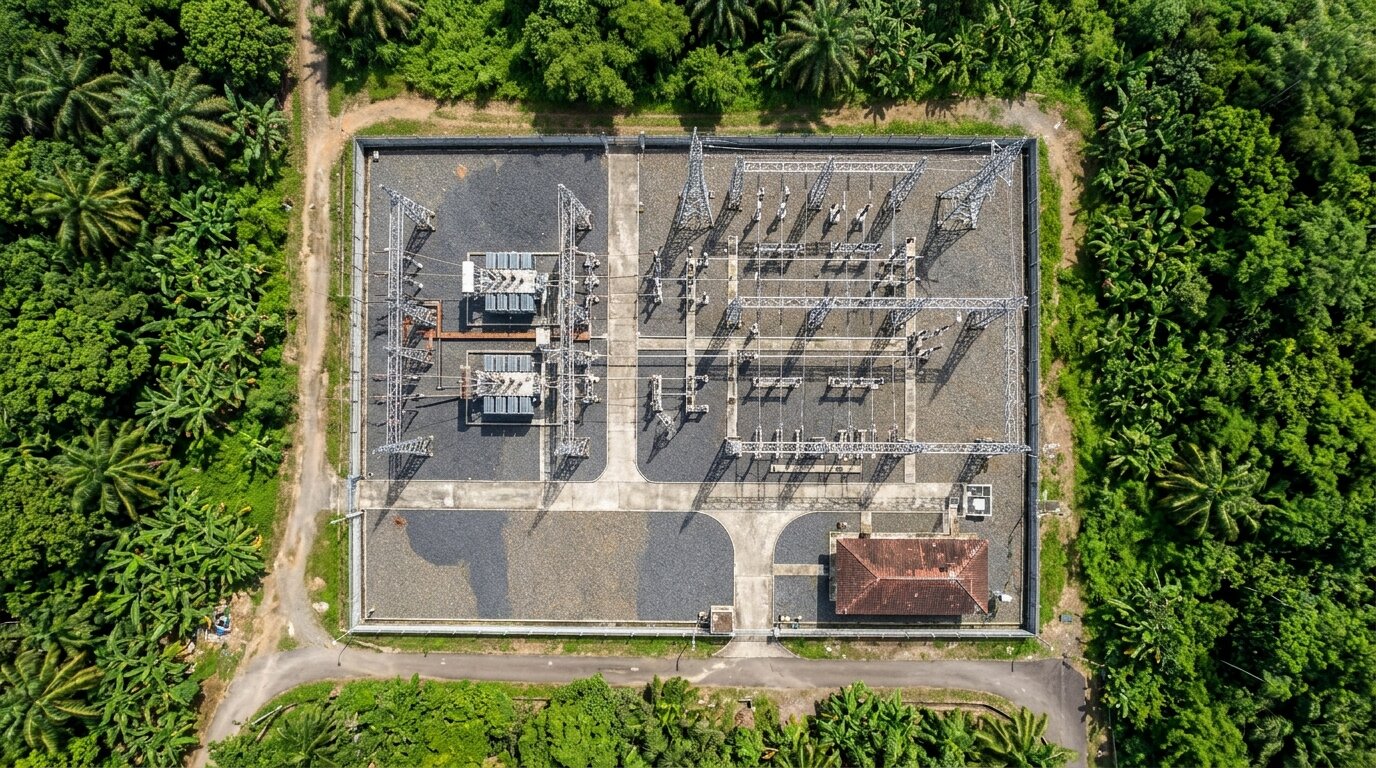
Power is different. Nearly all transmission and distribution in Indonesia runs through PLN, the state utility. Whether a site can draw tens or hundreds of megawatts depends on spare capacity at nearby substations, the condition of the lines that feed them and PLN's own plans for new capacity. None of that is visible on a site visit, and none of it can be fixed by paying more for the land.
The result is a familiar pattern. A buyer secures land, designs a campus, and only then learns that the nearest substation is close to full, or that a new connection depends on a line that is years from completion. The land is fine. The project waits.
What a grid test actually covers
Being near a transmission line is not the same as having power. A useful grid test answers five questions.
- Capacity. How much load can the nearest substations take today, and how much is already promised to other customers?
- Voltage and route. Large loads usually connect to the high-voltage network rather than local distribution, which means new bays, new lines or a dedicated substation. What has to be built, and where does the route run?
- Timing. When could the connection realistically be energised, and what has to happen first: approvals, a corridor for the line, equipment with long lead times?
- Redundancy. Can the site take two independent feeds, so that one fault does not take the campus down?
- Growth. If the first phase works, is there a path to the second and third phases without starting again?
Each answer depends on information held by PLN and on conversations that take time. That is why the grid test needs to start first, not after the land deal closes.
Why AI makes the problem sharper
A conventional enterprise data hall might run racks at 5 to 15 kW each. AI training and inference clusters run far denser, commonly 40 kW per rack and in some designs well over 100 kW. The same building footprint can therefore need several times the power, and the campus as a whole is planned in tens or hundreds of megawatts rather than single figures.
That changes which sites are viable. A plot that would comfortably host a 10 MW facility may have nowhere near enough headroom for an AI campus. It also changes the cost of being wrong. When the building, the cooling plant and the hardware orders are all sized around a power date, a delay of a year is not a scheduling problem. It can break the investment case.
How to test power before you buy
The aim is to learn as much as possible about the grid while the land is still optional. A practical sequence looks like this.
- 1.Shortlist several plots, not one, and map each against nearby substations and high-voltage lines.
- 2.Open early conversations with PLN about capacity in the area and the reinforcements planned in the RUPTL, PLN's ten-year supply plan.
- 3.Secure the land on terms that leave time for the grid work: an option, a conditional agreement or a staged purchase.
- 4.Commission a connection study and agree the route, the substation solution and who builds what.
- 5.Make the formal load application once the campus phasing is clear, so the request matches what will actually be built.
- 6.Design backup and redundancy alongside the main connection, not after it.
This sequence will not suit every deal. Some sellers will not grant options, and some estates already have power allocated to their plots. The principle still holds: protect your capital until the power picture is clear.
Where on-site generation fits
On-site generation and renewable supply help, but they rarely replace a strong grid connection for a large campus. Backup generators cover outages, not normal operation. Solar on a campus roof makes a small dent in an AI load. Larger renewable projects such as geothermal or hydro are built where the resource is, not where the data centre is, and still rely on the grid to carry the power. We look at the options in clean power for data centres in Indonesia.
Where captive generation is permitted and makes sense, it should be designed together with the grid connection, not brought in to rescue one that arrives late.
What this means for landowners
For landowners and industrial estates, the lesson cuts the other way. Land with a credible power story is worth more to data centre buyers than land with a lower price and an unknown connection. Gathering what you can about nearby substations, existing allocations and room for a line corridor makes a plot far easier to sell, and harder to discount.
What this means for you
If you are weighing a site in Indonesia, treat the grid as the first workstream, not the last. Name the substation, understand the route, get a realistic date, and keep the land deal flexible until you have all three. It is the single most effective way to stop capital sitting idle.
Our Grid work starts at exactly this point. If you have a site in mind, check it against the six Gs or talk to us about what a connection could look like.